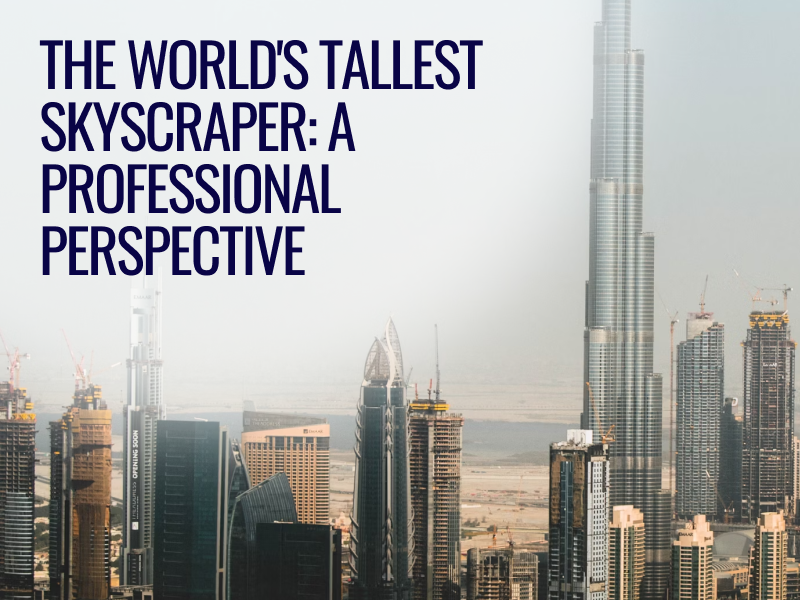
🏗️ Burj Khalifa: Architecture that defies gravity. What do the professionals know?
When it comes to the Burj Khalifa, they more often talk about records. And no wonder - since 2007, it has consistently held the first place among the world's tallest buildings. Its construction cost 1.5 billion dollars. But for experts, the real magic lies in the innovations that made this skyscraper possible. This is the story of how the symbiosis of architecture and engineering conquered a new height.
The dream team: Who was at the origin?
- Architectural firm: Skidmore, Owings & Merrill (SOM), authors of iconic skyscrapers from Willis Tower to the WTC.
- Chief architect: Adrian Smith. It was his concept of the "experimental flower" Hymenocallis that became the basis for the famous "Y-shaped" structure that provides stability.
- Chief Engineer: Bill Baker. Developed the revolutionary "needle" ledge system that was the answer to extreme wind and seismic loads.
Engineering genius: How was it built?
1. "Buttressed Core system in combination with a special building shape:
- Essence: Six strong buttresses surrounding a central core of stiffness. Every 30 floors, the buttresses recede to form ledges.
- Result: 25-30% reduction in wind load compared to traditional box structures. The tower "cuts through" the wind rather than resisting it.
2. High Strength and Heat Resistant Materials:
- Concrete: Special low permeability formulation that was poured overnight with ice added to prevent cracking at +50°C.
- Cladding: Double glass with reflective coating and thermal insulation to withstand the desert heat.
3. Smart vertical logistics:
- Special pumps were used to lift the concrete to a record height of 606 meters.
- Elevator system with transfer floor system (sky lobbies) for efficient movement - 57 elevators and 8 escalators in total
Technological innovations that changed the industry:
- Real-time monitoring: A network of sensors throughout the building monitors roll, vibration and temperature deformations.
- Energy efficiency: Condensate recovery system from air conditioning systems (up to 40 million liters of water per year to irrigate green spaces).
- Special foundation: Deep pile foundation (up to 50 m) designed for difficult ground conditions.
IMPORTANT: the building was designed with its own lawns, boulevards and parks. The building is multifunctional: it has a hotel, restaurants, offices, apartments and observation decks.
Why is this relevant for us today?
The experience of Burj Khalifa proved that the key to super high-rise construction is not in raw materials, but in the optimization of forms and calculations. Its principles are now used in projects all over the world, including Russia's Lakhta Center and Moscow City.
Conclusion for professionals: Burj Khalifa is not just a building. It is a textbook of interdisciplinary collaboration where architecture, engineering and technology come together to prove that limits exist only to be overcome.
(The photo for the post was AI generated)
#BurjKhalifa #HighriseBuilding #SOM #Architecture #icm_interesting
When it comes to the Burj Khalifa, they more often talk about records. And no wonder - since 2007, it has consistently held the first place among the world's tallest buildings. Its construction cost 1.5 billion dollars. But for experts, the real magic lies in the innovations that made this skyscraper possible. This is the story of how the symbiosis of architecture and engineering conquered a new height.
The dream team: Who was at the origin?
- Architectural firm: Skidmore, Owings & Merrill (SOM), authors of iconic skyscrapers from Willis Tower to the WTC.
- Chief architect: Adrian Smith. It was his concept of the "experimental flower" Hymenocallis that became the basis for the famous "Y-shaped" structure that provides stability.
- Chief Engineer: Bill Baker. Developed the revolutionary "needle" ledge system that was the answer to extreme wind and seismic loads.
Engineering genius: How was it built?
1. "Buttressed Core system in combination with a special building shape:
- Essence: Six strong buttresses surrounding a central core of stiffness. Every 30 floors, the buttresses recede to form ledges.
- Result: 25-30% reduction in wind load compared to traditional box structures. The tower "cuts through" the wind rather than resisting it.
2. High Strength and Heat Resistant Materials:
- Concrete: Special low permeability formulation that was poured overnight with ice added to prevent cracking at +50°C.
- Cladding: Double glass with reflective coating and thermal insulation to withstand the desert heat.
3. Smart vertical logistics:
- Special pumps were used to lift the concrete to a record height of 606 meters.
- Elevator system with transfer floor system (sky lobbies) for efficient movement - 57 elevators and 8 escalators in total
Technological innovations that changed the industry:
- Real-time monitoring: A network of sensors throughout the building monitors roll, vibration and temperature deformations.
- Energy efficiency: Condensate recovery system from air conditioning systems (up to 40 million liters of water per year to irrigate green spaces).
- Special foundation: Deep pile foundation (up to 50 m) designed for difficult ground conditions.
IMPORTANT: the building was designed with its own lawns, boulevards and parks. The building is multifunctional: it has a hotel, restaurants, offices, apartments and observation decks.
Why is this relevant for us today?
The experience of Burj Khalifa proved that the key to super high-rise construction is not in raw materials, but in the optimization of forms and calculations. Its principles are now used in projects all over the world, including Russia's Lakhta Center and Moscow City.
Conclusion for professionals: Burj Khalifa is not just a building. It is a textbook of interdisciplinary collaboration where architecture, engineering and technology come together to prove that limits exist only to be overcome.
(The photo for the post was AI generated)
#BurjKhalifa #HighriseBuilding #SOM #Architecture #icm_interesting